


July, 2024: Joint research by paleontologists from Mexico and Badlands Dinosaur Museum has reassessed the position in time of the Mexican horned dinosaur Coahuilaceratops magnacuerna, shedding light on an evolutionary split within the horned dinosaurs’ history and fills in gaps in the fossil lineage leading to Triceratops.
(Read the paper here, Free: https://www.mdpi.com/1424-2818/16/7/390 )

Key findings:
- A reidentification of the host rock shows that the horned dinosaur Coahuilaceratops actually comes from the Cerro Huerta Formation and up to 2.5 million years younger than previously thought.
- This research builds upon a hypothesis that in the Late Cretaceous of North America, intermittent high seal level separated dinosaur populations into northern and southern populations, laying the foundation for an evolutionary splitting event and providing an explanatory mechanism for the apparent differences between northern and southern faunas.
- The southern Pentaceratops lineage underwent a second evolutionary split (cladogenesis) ~72.5 million years ago, separating into a northern lineage which evolved into Anchiceratops and a southern lineage which gave rise to the Triceratopsini.
Contacts:
Primary author: daniela.bee.gee.64 [at] gmail.com (daniela[dot]bee[dot]gee[dot]64[at]gmail[dot]com)
Senior author and Badlands Dinosaur Museum curator: Denver Fowler https://www.dickinsongov.com/museum-center/directory-listing/dr-denver-…

Background
The Difunta Group in the southeastern part of Coahuila, northern Mexico has produced a remarkable number of fossil discoveries in the past two decades.
The Cerro del Pueblo Formation in the southeastern part of Coahuila, northern Mexico has produced a remarkable number of fossil discoveries in the past two decades, including all dinosaurs named from the region. This formation has been dated to the Campanian stage of the Cretaceous, around 73 - 72.5 million years in age. It is interpreted as a coastal subtropical environment, marked by grey and beige mudstones and sandstones.
The Cerro Huerta Formation overlays the Cerro del Pueblo Formation and no diagnosable dinosaur fossils had previously been reported from this geological unit. It is distinctly identified by red siltstones, interpreted as an inland continental environment. It is dated to the early Maastricthian stage of the Cretaceous, around 71.5 - 70.5 million years in age.

An unexpected discovery
In order to make comparisons with some newly discovered dinosaur fossils, a team of Mexican, American and British paleontologists revisited the quarry from which the original specimen of the horned dinosaur Coahuilaceratops had been collected in the early 2000’s. Upon arrival Dr. Belinda Espinosa Chávez noticed the quarry horizon was bounded by distinctive red rocks. This indicated that the Coahuilaceratops quarry was not hosted within the Cerro del Pueblo Formation, but was in fact from the younger Cerro Huerta Formation, and up to 2 million years younger than previously thought.
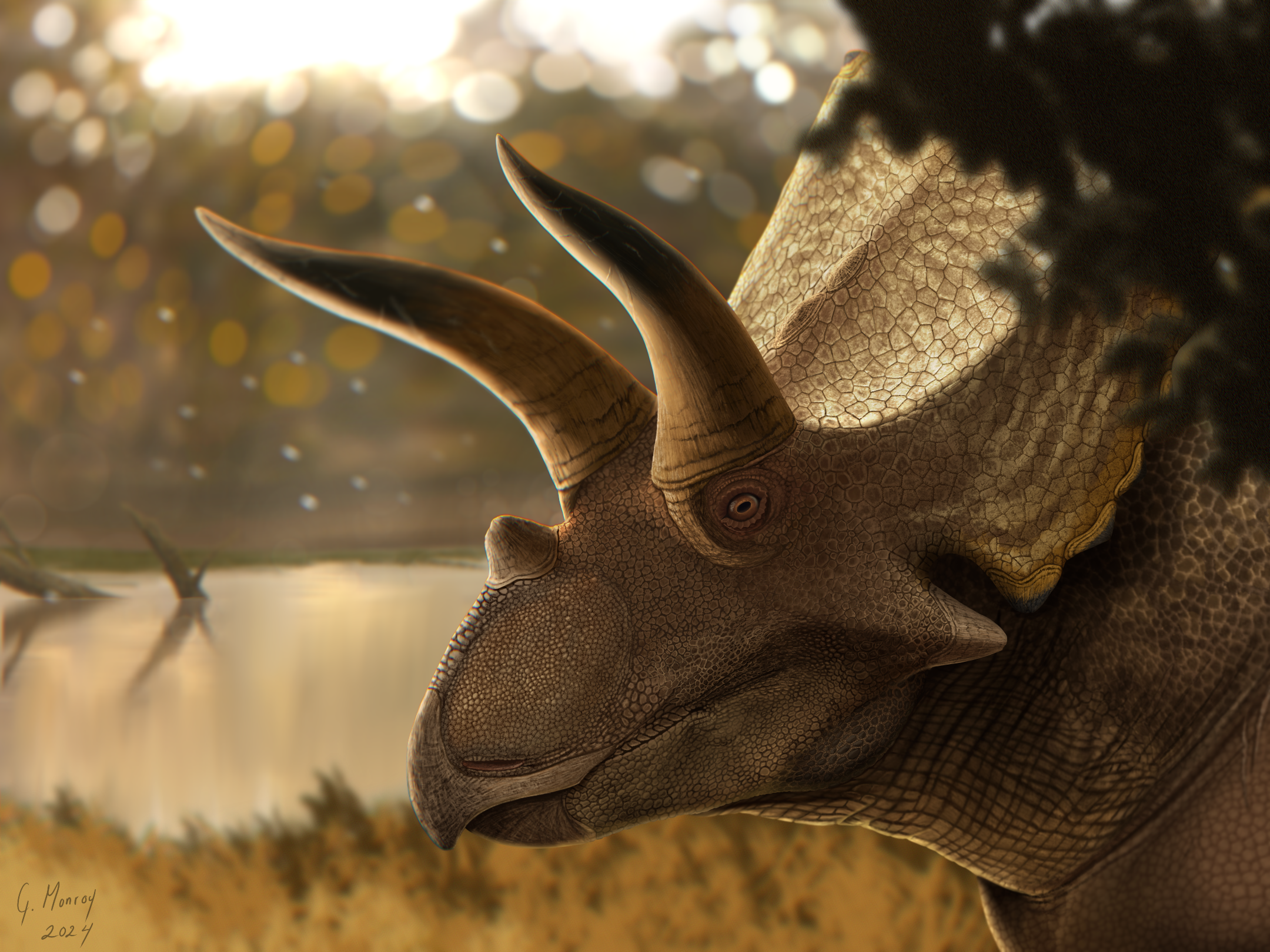
This actually makes evolutionary sense since Coahuilaceratops shows features of its skeleton that look more advanced than expected if it was from the older Cerro del Pueblo. These features are also seen in advanced species related to Triceratops: e.g. forward positioned nose horn, massive horns above the eyes and raised bumps on the midline of the frill. Due to these features, Coahuilaceratops may represent the earliest member of the Triceratops lineage, lending further credence to the hypothesis that this lineage originated in southern North America.

Another evolutionary split!
Previous research by Badlands Dinosaur Museum’s Dr. Denver Fowler and DSU’s Elizabeth Freedman Fowler revealed a splitting event deep in the evolutionary history of long-frilled ceratopsids (chasmosaurines).
This evolutionary split occurred during the Late Cretaceous Period, when a vast interior seaway flooded the lowlands of North America dividing it into eastern and western subcontinents. A short period of especially high sea level ~83 - 81 million years ago brought the shoreline of the seaway right up against the young Rocky Mountains between what is now central Utah to southern Alberta, effectively cutting off northern and southern populations of chasmosaurine horned dinosaurs. These then evolved in isolation into a southern “Pentaceratops lineage” evolving a progressively deepening notch in the frill, contrasting against a northern “Chasmosaurus lineage”, which evolved a progressively shallower notch. However, ~80 - 78 million years ago, the sea receded from the mountain front, permitting the southern Pentaceratops lineage to migrate north. Eventually the Chasmosaurus lineage went extinct, leaving the Pentaceratops lineage to inhabit the lowlands of ancient western North America.
In this new study, it is hypothesized that a second splitting event may have occurred within the Pentaceratops lineage. Where another period of high sea level divided northern and southern populations of Pentaceratops, which then evolved in isolation into two distinct lineages approximately 72.5 million years ago. The northern population would evolve into the bizarre Anchiceratops and Regaliceratops from Canada, while the southern population evolved into the Triceratops lineage, Coahuilaceratops being one of these early representatives. Roughly around 71.5 million years ago, the sea would recede once again from the mountain front. Shortly after this, the northern Anchiceratops - Regaliceratops lineage goes extinct, leaving the southern Triceratops lineage to inherit the entire subcontinent.

Conclusions
Coahuilaceratops is the first known dinosaur from the Cerro Huerta Formation, and therefore represents a brand new fauna in the Late Cretaceous of southern North America. Furthermore, the possibility exists that other Dinosaur fossils may already exist that have also been collected from the Cerro Huerta, but might have been similarly misidentified.
About the researchers
Daniela Barrera Guevara, Undergraduate student at Dickinson State University, North Dakota; Research Associate at the Badlands Dinosaur Museum and Benemérita Escuela Normal de Coahuila.
Dr. Belinda Espinosa Chávez, Professor at Universidad de Ciencias Geológicas y Sociales and Research Associate at the Benemérita Escuela Normal de Coahuila.
Dr. Claudia Inés Serrano Brañas, Professor at Universidad de Ciencias Geológicas y Sociales and Research Associate at the Benemérita Escuela Normal de Coahuila and the Smithsonian National Museum of Natural History.
Claudio de León Dávila, Independent Researcher and Local Field Paleontologist from Coahuila, Mexico.
Daniel Posada Martinez, Independent Researcher and Local Field Paleontologist from Coahuila, Mexico.
Dr. Elizabeth Freedman Fowler is Assistant Professor of Biology at Dickinson State University, ND.
Dr. Denver W. Fowler, Curator of Badlands Dinosaur Museum, Dickinson Museum Center, Dickinson, North Dakota.
About the artist
Head reconstructions by Gustavo Monroy, Mexican paleoartist and student at the National Autonomous University of Mexico, who creates digital illustrations. More of his work can be found on his Instagram (https://www.instagram.com/paleoart_by_g.monroy/) and Twitter (https://x.com/gmonroyb1) accounts.
Life reconstruction of Coahuilaceratops in its environment by SauriaZoicIllus, Australian palaeoartist who illustrates a wide variety of different clades. More of their work can be found on https://linktr.ee/ppaleoartist


Reference: Barrera Guevara D, Espinosa Chávez B, Serrano Brañas CI, de León Dávila C, Posada Martinez D, Freedman Fowler E, Fowler D. Stratigraphic Reassessment of the Mexican Chasmosaurine Coahuilaceratops magnacuerna as the First Diagnostic Dinosaur Remains from the Cerro Huerta Formation (Lower Maastrichtian) Supporting the Southern Origin of the Triceratopsini. Diversity. 2024; 16(7):390. https://doi.org/10.3390/d16070390
Imagery: All images are provided here for publicity & media purposes or sharing on social media (click for full resolution).
Full Sized Imagery
For those in need of a larger-than-life version of any image gracing this page, simply direct your attention to the slideshow on the left. Once there, pinpoint the desired image, and with a right-click, select "Open Image in New Tab" for an expanded visual delight.